
Input from Richard Goodman, Larry DiCostanzo and Bill Bagnell
First from Richard:
Fiction
Russell Banks, Magic Kingdom (2022). Since I am drawn to books that take me to times and places new to me, I reveled in this tale of rural Florida in the early 20th century and the Shaker community that first thrived, then struggled there.
Geraldine Brooks, March (2005). This novel reimagines the life of Mr. March (the unseen father in Little Women) as a chaplain during the Civil War. With luminous prose, it shines a light on the wretched lives of the newly released slaves, of the unimaginably horrible front lines and of the grim conditions in Civil War hospitals.
Percival Everett, James (2024). This novel retells the story of Huckleberry Finn from the standpoint of the enslaved Jim (here, called “James”). Although it may be heresy to admit this, I enjoyed James more than Mark Twain’s original, which I reread at the same time!
Bernard Malamud, The Fixer (1967). This novel, which won both the National Book Award and the Pulitzer Prize in 1967, is based on the true story of a poor Jew in Tsarist Russia who is accused of the ritual murder of a Russian boy. Difficult to read but impossible to put down.
Gary Shteyngart, Vera, or Faith (2025). This dystopian tale follows a precocious 10 year old girl (Vera) in near-future America. The story, told from Vera’s perspective, follows her attempts to connect with her Korean-American birth mother and to hold together her (very!) blended family as it struggles with rising authoritarianism. Somber yet hilarious!
Wallace Stegner, The Angle of Repose (1971). This Pulitzer Prize–winning novel weaves together the story of a retired historian confined to a wheelchair and the 19th-century frontier lives of his grandparents, whose letters and papers he is studying.
Elizabeth Strout, Olive, Again (2019). This novel, told through interconnected stories, focuses on Olive Kitteridge,
a prickly retired math teacher from Crosby, Maine featured in a previous Strout novel. It spans roughly a decade of Olive’s later life as she navigates aging, loneliness, love, regret, and connection. You can’t go wrong with this or with any of Strout’s novels!
Non–Fiction ——————–
Frances Dinkelspiel, Towers of Gold (2008). This is a biography of the author’s great-great-grandfather, Isaias Hellman, a Jewish immigrant who rose from penniless store clerk to powerful financier in California. It chronicles how Hellman’s financial acumen and investments in industries like banking (including Wells Fargo), transportation, viticulture, and oil played a pivotal role in transforming California from a raw frontier into a modern economy. A terrific read!
Richard Federko, A Walk in the Park (2024). Just how many things can go wrong when you attempt to hike the entire Grand Canyon? More than you can imagine!
Stephen Greenblatt, Dark Renaissance (2025). I had no previous interest in Christopher Marlowe and knew only that he was a contemporary of Shakespeare. My bad! Marlowe’s story, told by a master storyteller, is as fascinating as that of the Bard of Avon!
Patrick McGee, Apple in China (2025). McGee chronicles the background of Apple’s placing all of its bets on China, currently doing 90% of its manufacturing there. It is thereby putting itself at great risk as well as training China’s next generation of engineers, who may go on to develop hostile technology.
Russell Shorto, The Island at the Center of the World (2004). Who knew that New Amsterdam, the Dutch colony that became New York, was the font of American diversity or that a a Dutch-born lawyer named Adriaen van der Donck was the true father of the liberties we cherish?
Ian Tattersall, Masters of the Planet: The Search for Our Human Origins (2012). This book explores how Homo Sapiens became the dominant species on Earth, focusing on the unique traits that allowed us to outcompete other human species, such as Neanderthals.
Amanda Vaill, Pride and Pleasure: The Schuyler Sisters in an Age of Revolution (2025). Having revered Ron Chernow’s Hamilton in 2016, I wondered what more there was to say about this man and his family. Much, much more, it turns out, especially when the focus is on his wife and sister-in-law!
Irvin Yalom, Becoming Myself: A Psychiatrist’s Memoir (2017). Yalom arose from an impoverished immigrant home to become a foremost modern psychotherapist, writing numerous books along the way (I read three of his other books this year, as well as this one!)
My very favorite books this year were:
Fiction – Brooks, Geraldine, March (2005).
Non-Fiction – Stephen Greenblatt, Dark Renaissance (2025).
Happy New Year and happy reading to all of you!
Now from Larry DiCostanzo:
My friend, Richard Goodman, has inspired me yet again to send out my list of favorite books of 2025. The fact is that I didn’t get time to read a lot, given how our year was one of medical extravaganzas. I think I did “comfort reading” — old favorites, a book I read as a child, and some books about the medieval world. Everything on the list is fiction. Larry
Here you go:
The Brothers Karamazov by Fyodor Dostoyevsky: Once again I’ve read this great murder mystery that, like many modern mystery movies, closes with a trial. The eponymous brothers and many others are portrayed as unique individuals with intense interactions and flights of individualism. The contrasts are great and wonderful: for example, a very serious scene followed by the most beautiful description of a happy dog in love with his young master.
Pride and Prejudice by Jane Austen: It always pays to reread a good book and shake off one’s bias. This time, I finally realized that both the pride and the prejudice were the traits of the heroine Elizabeth Bennett and that Mr. Darcy is, in fact, the good guy. This is a delightfully complicated book with insights into how law and society influence character. P.s. Did you know this is the 250th anniversary of Miss Austen’s birth? That by happenstance I came across her grave in Winchester Cathedral?
Paradise Lost by John Milton: I am not quite sure if Mr. Milton “justified the ways of God to Man” as he had hoped. But he was certainly valiant. Plus he wrote a hard-to-read (for us) but verbally exciting story that is like super science fiction in many respects (think battles in space), fantasy in others (think evil guys holding conferences) and an excellent retelling of the story of Adam and Eve as people who don’t really have much experience and certainly don’t have a past. Not for the faint hearted.
The Heat of the Day and The Death of the Heart by Elizabeth Bowen: Miss Bowen is an Anglo-Irish woman who wrote from the 1930s through about 1960. The first book is a World War Two story in which a widowed English woman with a son in the army has to worry about whether her English lover is actually a mole or agent for Germany. The second book is pre-war and concerns how a young person loses trust because of one single event: An adult exercises thoughtless privilege to read her diary without permission. Bowen is a serious writer and, I think, an amazing stylist.
The Pickup by Nadine Gordimer: In this relatively short book, Nadine Gordimer tells the story of a privileged young South African woman who meets a car mechanic who is an illegal alien with high intelligence, dissatisfactions, and hopes. He is caught out, they marry, and must move to his unnamed Islamic desert country. Conflict arises as she discovers she is content there, and he is always seeking escape. This is a beautiful book.
Grettir’s Saga by Anonymous: This book is one of the many Icelandic sagas written down in the 13th century, but harking back to earlier Viking times. These sagas are actually novels. This one is about the obsessively individualistic Grettir and how his asocial attitude leads to the disaffection of his fellows, to his isolation, and friendlessness. Believe me, friendlessness in medieval Iceland in no joke. The scenery and the way of life are well portrayed — indeed, so well that the editors add maps showing Grettir’s travels. If you think such early Viking age literature might be hard to get into, think again please.
River of Stars by Guy Gavriel Kay: This is a fantastic, rip-roaring book about a fantasy China under siege from steppe barbarians to the north. It is a great companion to “Under Heaven” also about fantasy China, and which I wrote about in an earlier list. Here there is poetry, sad ruin, cynical governance, savagery, a young man who rises from the bottom, unmerited failures and successes, and struggles between noble aspirations and loyalty. This is a page-turner.
Laurus by Eugene Vodolazkin: The high quality of the literature coming out of modern Russia is amazing. “Laurus”, set in the 1400s, is the fictional biography of a “holy fool”, a character that appears elsewhere in Russian art, for example, in Moussorgsky’s opera “Boris Godunov” or perhaps in Dostoyevsky’s “The Idiot”. This is a beautiful book with macro- and micro-landscapes (think forest and different kinds of moss and fungus), magic moments as in hagiography and a consistent narrative of a man whose whole life is determined by a youthful act of selfishness.
The Wheel on the School by Meindert DeJong: I must have read this book (about 300 pages) when it won the Newbury Medal in 1955. The teacher in a small school in a “stork-less” village in Friesland turns the kids loose to complete a project which is also a dream — to find a wagon wheel to put on top of the school for storks to nest on. The children have wonderful experiences as they forage. And I have never read a book in which the meeting of the world of children with the separate world of adults is so well done. There are great people like the legless fisherman and great visuals like the tinker’s horse wagon. Excellent values in a real world. Illustrations by a young Maurice Sendak.
Bill Bagnell’s List
I read the first three books in high school but may not read the others. For some reason that I don’t fully understand, I can’t seem to get into fiction these days, all I read is non-fiction. Here are a few to try:
Sexuality in Medieval Europe by Karras and Pierpont (I was curious);
The Making of the Atomic Bomb by Richard Rhodes (a bit technical but a wonderfully written story about how basic research and brilliant people led to a massive WW2 effort to create a most terrible weapon);
The Death of Meyerhold by Mark Jackson (local playwright Jackson wrote this years ago for Shotgun Players, who are reviving it in a new production at the end of 2026. Script is available on Amazon, play will be a must-see, and sometimes reading a script in advance of seeing the production can enhance the experience).
Bill Bagnell
Life is a strange attractor
Gods are the tapeworms of the mind
Best Non-fiction and Best Book of the Year!
Super-Infinite: The Transformations of John Donne
by Katherine Rundell
This biography is a relatively short and superb review of the life and white-hot mind of our greatest poet of sexuality and also our most astounding preacher (as in “for whom the bell tolls”). The author, who has a gift for words herself, says Donne took Elizabethan love poetry down a dark alley and knifed it. Later in life, he filled St. Paul’s Cathedral in London with avid listeners. His years of hardship were more numerous that his years of success, but he was a loyal husband and the father of seven living children whom he raised on his wife’s death.
Best Fiction
Cancer Ward
by Aleksandr Solzhenitsyn
This long novel is a panorama of Soviet society in the time of Stalin as seen through the lens of a cancer hospital. But it is also an achingly gorgeous and slow love story between a physician and a patient who is a rough-and-ready permanent exile. The last pages at the least rival the last pages of Tolstoy’s Anna Karenina.
The Fiction I Liked
I see that, this year, my favorites were not contemporary books. But, I tell you, the nineteenth century and the 1940s produced some incredible stuff.
My Cousin Rachel
by Daphne Du Maurier
I found this in a street-side library and said “What the heck.” Well, what a great book, and now I see why Miss DuMaurier was so famous. The author does not interpret what’s going on. IMO it is a story of the mental illness of an unlikely candidate. Intense.
Dubliners
by James Joyce
Wonderful stories about nice people, drunks, men who play on women to get petty amounts of money, etc. It has one of the best stories on drunks that concludes with impending domestic violence that will make you so sad.
The Way of All Flesh
by Samuel Butler
This author is an incredibly elegant and easy writer. The book is what I think is called a bildungsroman, the history of a young man from childhood to adult. And this kid has quite a path that includes a clergyman father, prison, an unwise marriage, etc., etc. It is amazing to me to read the violence with which boys used to be raised. (Beatings occur in another book of the 19th that I read this year.)
The Tale of the 1002nd Night
by Joseph Roth
The author had been a journalist, and this may be why he has an eye for story. A brief royal sexual intrigue affects the lives of the people involved in it. How can a girl who honestly came by the money involved, lose it over time, and end up in jail? How can the noble cavalryman who loves her (but won’t admit it) end up losing his self-esteem and his money because of her. A great story.
Ivanhoe
by Sir Walter Scott
Yes, I read this entire old chestnut. People think of Sir Walter as a romantic, but he is definitely not. His book is full of nasty, greedy people, and Ivanhoe is rather dumb as is Richard the Lion Heart. The shining light is Rebecca, the Jewish maiden, who can articulate for us the life of an outsider. Sir Walter deserves a rethink.
Imperium
by Richard Harris
Mr. Harris writes about ancient Rome, and he did a fabulous book called Pompeii. Imperium is about the early career of Cicero when the Roman Republic was being undermined. It is a great novel of law and politics by a writer who knows his stuff. I should tell you there are no gladiators, bloodshed, or mayhem.
Marrow and Bone
by Walter Kempowski
Kempowski obliquely visits a great German trauma — the 1945 winter flight of the civilian population of East Prussia before the advancing Soviet army. In 1988, the protagonist, who was born during the flight, gets a chance to tour East Prussia as part of a group planning a car rally. He comes on the places of his parents’ deaths and is transformed from a dilettantish, youthful life, to a directed adult life. A lovely book, with some laugh-out-loud passages.
The Non-Fiction I Liked
Reader Come Home
by Maryanne Wolf
We all love to read, and Prof. Wolf tells points out that reading is a marvel of the plastic mind because we are not genetically disposed to read. She talks about deep, reflective reading, and the good use of digital reading. She realizes we have to read in both realms, and her ideas about being “biliterate” are great. You can catch her utterly charming presence on an Ezra Klein podcast of 2023. Her voice and intelligence turned me onto this book.
Ancient Iraq
by Georges Roux
Mesopotamia has always fascinated me, and M. Roux satisfies the hunger. He wrote about the subject originally for an oil company magazine, and then transformed his work into a book that covers pre- and early history, the Sumerians, and onward through the Babylonians and Assyrians with clear presentations of the many other peoples who have stomped over this territory — Aramaeans, Hittites, Amalekites, Elamites, et al. Due to clay tablets, we probably know more about day-t-day history there than for practically any other age. Amazing.
All the best for the New Year,
Larry/Lawrence/Lorenzo
Story found in a local email stream.
——–
This is a sad tale. The story has a villain and a victim. I am the villain, and my bike is the victim.
It all began on another perfect bay area biking Saturday. I met a couple of friends at Teatro in Orinda and we had a wonderful ride. When I returned to the car, I put my bicycle on the rack on the back of my car. Then, I must have gotten distracted. How?
Did I turn to say goodbye to someone? Maybe.
Was I focused on my audible book? Maybe. After all, I was on the last 50 pages of Neal Stephenson’s 3,000+ page Baroque Cycle and I wanted to see how it would end!
Is this an example of normal human error and fallibility? Absolutely. At least that’s what I’m telling myself to feel better.
Anyway, there is a small step after putting the bike on the rack that I seem to have overlooked. It involves securing the bike to the rack, and evidently it is an important step. I’ve had this bike rack for years, and I figure I have put my bike on it over a thousand times. If you think about, one error in a thousand isn’t an awful percentage. However, my bike might have a different opinion.
You’re probably wondering how I realized I had skipped this small step. I drove back to Montclair in a wonderful mood after a great ride. I was low on gas so I stopped, and stood by my car as it drank it’s fill. But I didn’t notice anything amiss. After that I stopped at my favorite pizzeria to pick up lunch (one advantage of doing long bike rides is you get to eat pizza). When I pulled over in front of the pizzeria, I looked in my rear view mirror and thought ‘where’s my bike’. My next thought was ‘did I stop home and drop it off?’. My next thought was something along the lines of ‘OH S***’. For a moment I thought it had been stolen. But then I remembered that it had not been out of my sight since I left Orinda. It was at that moment I realized who was the villain in this story.
I was briefly tempted to say “Oh Well”, and just go home. Fortunately, I had enough common sense to not do that. I realized that if the laws of physics were still in force, my bike must be somewhere between the Orinda and Montclair. I contemplated the possibility that the laws of physics had briefly been suspended, as this would be preferable to my own stupidity being responsible for all this. But I knew that the latter reason was probably true, so I retraced my steps.
A friend had bikes drop off his rack with no damage, so I was a little hopeful. In fact I once jumped out of his car to rescue a bike on a busy highway. We expected it to be totaled but it was rideable, and I rode it off the freeway. Certainly my own bike could fare just as well? No such luck.
Like a wounded bird thrown from the nest, it lay by the side of the highway. As might be expected, it was just past the on ramp from Orinda. It’s a place where a car accelerates while going uphill which provides a perfect opportunity for a bike to simultaneously reach escape velocity yet still hit the ground at 40 or 50 miles per hour. In case you’ve been wondering, I have definitively proved that falling on the ground at high speed is not advised for a carbon frame.
The patient was announced DOA at Cycle Sports. Fortunately, the death will not be totally in vain. The components are salvageable, so they can be transplanted to some deserving young frame. Also, Trek has a crash replacement policy that I might be eligible for. I will know on Monday about this, and also how long it will take to Trek to gestate a new frame. It’s possible, because its a crash, that I will be expedited. If not, it could be up to a 3 month wait. I’m glad so many people have discovered the joy of cycling during the pandemic, but I’m wishing there was some way those of us who have kept the bike companies going all these years could get some priority. Evidently, getting a bike is now up there with getting a vaccine, the only difference being that my age doesn’t help. A friend was gracious enough to loan me his spare bike which I rode today.
Are you wondering why I have bothered to tell this tale of woe at such length? I explained all this in detail to some folks this morning and realized that I would have to repeat it many times. I decided that those who are interested can read this email and that way I won’t have to remind myself on multiple occasions just how lame I was. Also, being able to joke about it a bit makes it easier to stomach.
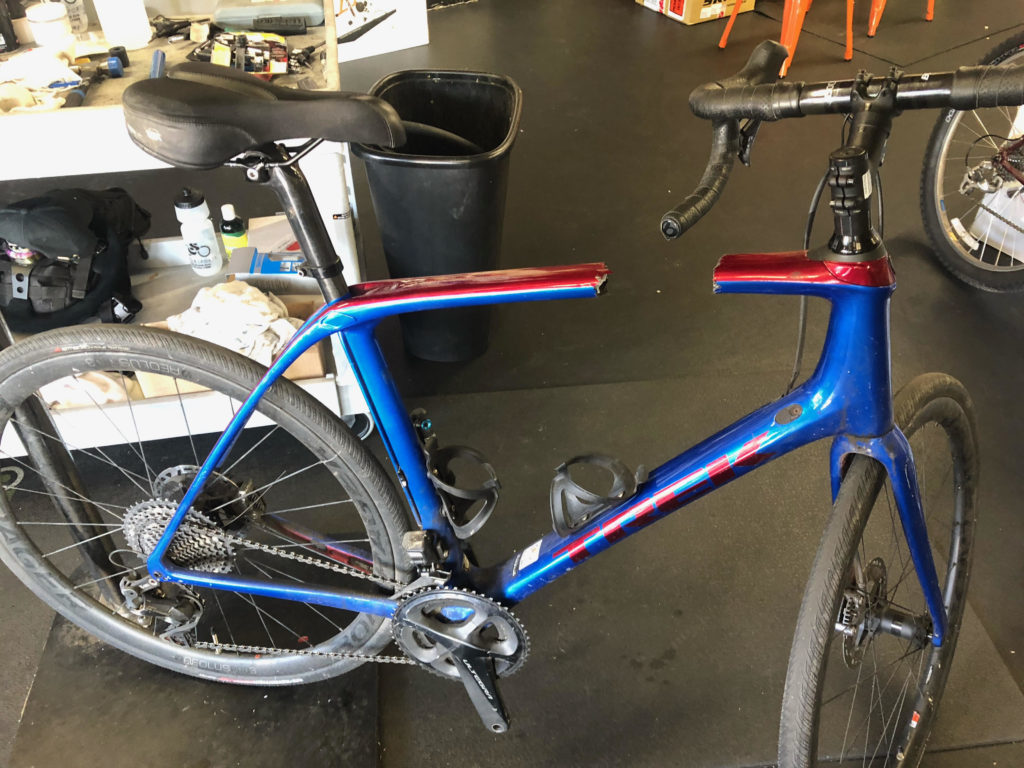
I know you have one more question. Exactly what happened to the bike?! A picture is worth a thousand words. I suspect that when you view the picture below you will agree that it wasn’t a good idea to ride it home. I’m not sure if bike abuse is a crime, but if it is, I’m going to need a lawyer.
KTRSD, but make sure it doesn’t hit the ground at high speed!
WARNING: The Photograph below contains images that may be uncomfortable for some viewers and may induce bike-accident nightmares. Viewer discretion is advised.
- January: The Underground Railroad by Colson Whitehead
- February: War and Turpentine by Stefan Hertmans
- March: The Undoing Project by Michael Lewis
- April: LaRose by Louis Erdrich
- May: On Tyranny: Twenty Lessons from the Twentieth Century by Timothy Snyder
Idea from Rob.
A lot of us love great books, and we have gotten up many hills discussing the books we have read. With that in mind, let’s try a book-of-the-month club for 2017. For those who are interested, here’s how it would work:
- At the beginning of each month I will send out an email with the title of this month’s book. If you want to read it, you can do so. Hopefully during the course of the month you’ll be on rides with others who have read the book and you can talk about it.
- If you don’t want to read it, don’t. This is totally optional for those who are interested.
- I am hoping that every month a different person will volunteer to suggest the book. I will organize and send out the monthly email. Let me know if you want to suggest the book for a future month.
- This has many of the benefits of a regular book club with none of the guilt. If you don’t feel like reading the book and don’t get around to it, there is no expectation. Added benefit – if you don’t really like the book and don’t want to finish it, but are mildly curious how it ends, you can find someone to tell you.
As I said, I’m hoping a different person will select a book every month. Since I’ve suggested this, I’ll go ahead and select the book for this month: The Underground Railroad, by Colson Whitehead. This book won the national book award and is one of the NY times five best fiction books of the year. It is a unique book that combines a historical novel with a touch of magical realism.